Private Fleet Net Zero
Building an autonomous system that catches what a manual check misses.
Private Fleet Net Zero connects freight buyers with private fleet trucks that return empty on 80% of their trips.
Previously, testing the marketplace meant manually completing a freight transaction from both sides. Prozan AI built software that now simulates the entire matching process every morning, checks that information stays consistent, and reports issues directly to the CEO. Within its first week, it identified two bugs missed during manual testing.

“I was impressed by how quickly Noah understood our business and got the system running. Within two weeks, we had an automated check that was already catching things we’d missed manually. It’s taken a repetitive task off our plate and gives us a much better picture of what’s happening in our marketplace before the workday even starts.”
The problem
A 13-step check by hand, every morning
Every morning, someone at PFNZ had to test the marketplace like a real customer. They’d log in as a fleet, enter a truck’s route, log out, switch to a buyer account, and enter a shipment. Then they’d wait for a match, open the emails, review the offer, send a counteroffer, accept it, and confirm the deal.
Thirteen steps, two accounts, multiple emails and pages. All repeated by hand to make sure the marketplace was working.
And because PFNZ releases new software frequently, a check that passed yesterday didn’t guarantee everything would work today. A change to one screen could affect matching, emails, or the pages customers use to complete a shipment.
Even completing every step wasn’t enough to catch everything. A pickup date could appear correctly in an email but incorrectly on a customer-facing page. The transaction would still go through, leaving conflicting information that was easy to miss when checking each screen individually.
The deliverables
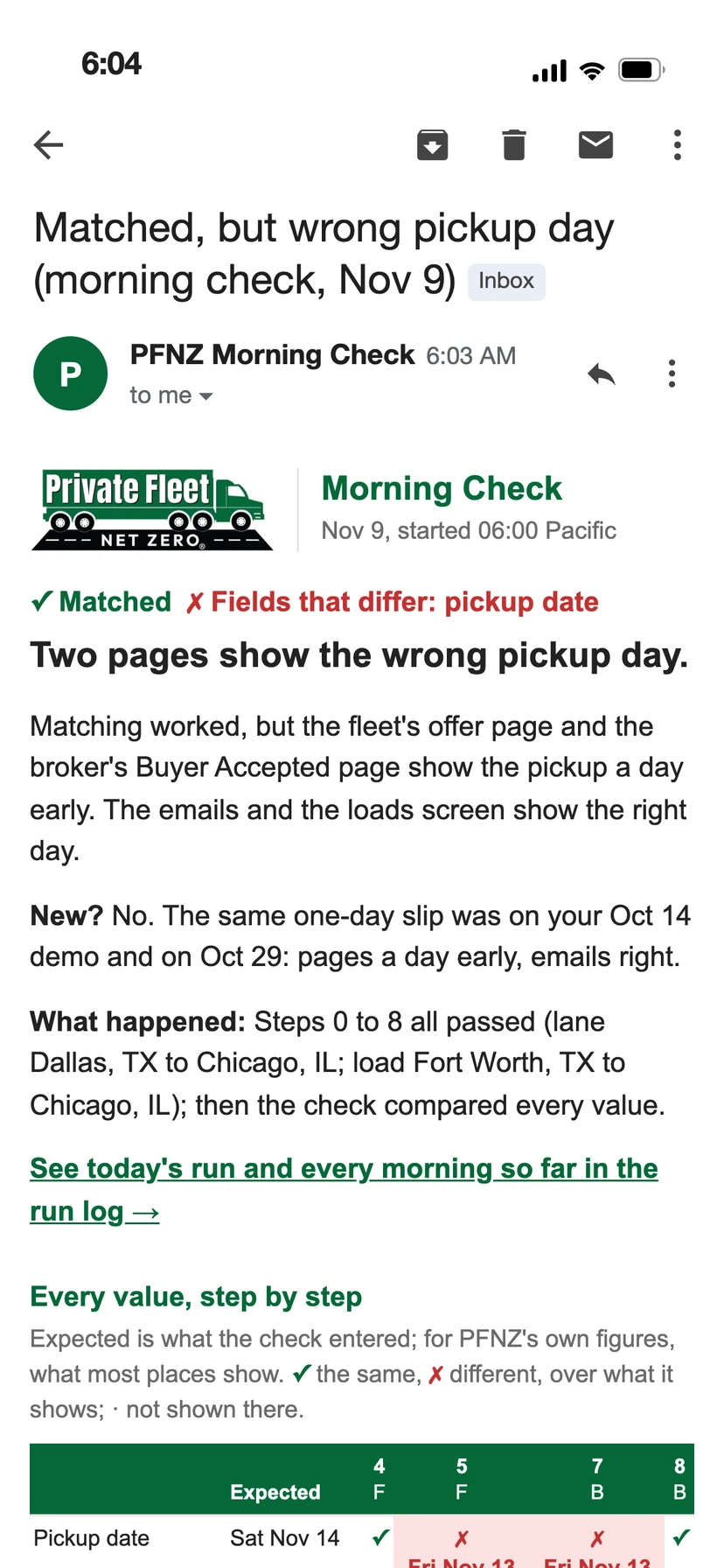
What lands before the workday
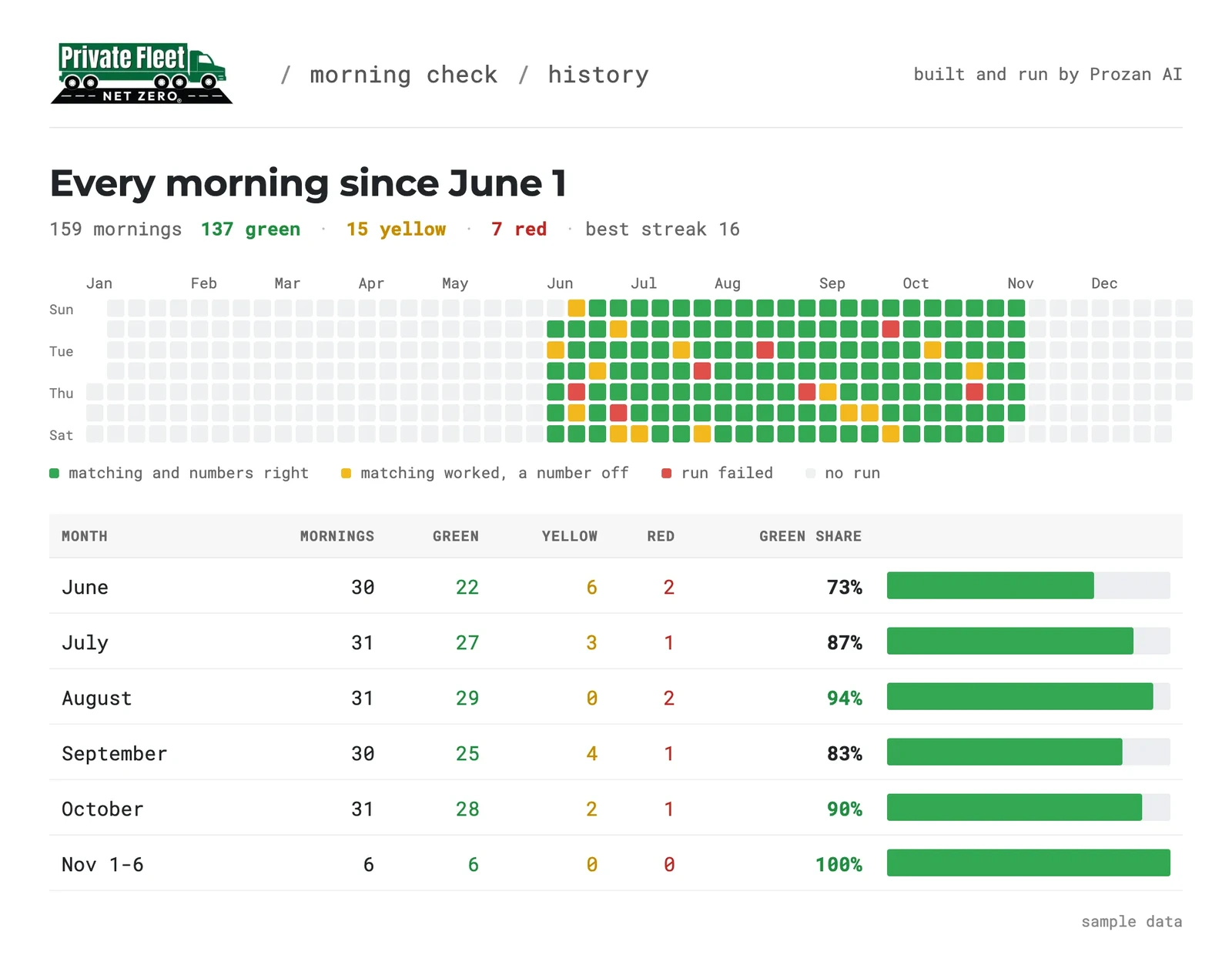
Also delivered
- A one-page guide
- Explains the daily reports, how to review test results, and how to pause or adjust the automated check.
- Commented code and a README
- So PFNZ’s own engineers can follow every step, run it on a laptop or move it into PFNZ’s Google Cloud account.
- Monthly support
- Ongoing maintenance, email support with quick response times, and AI strategy consultations to explore new opportunities for PFNZ.
What it found
The kind of error a manual check can’t see
In its first week, the check flagged a pickup date that read Saturday in every email but Friday on two customer-facing pages. A person checking one screen wouldn’t see it, and a fleet planning from the wrong page shows up a day early. The CEO had a report with screenshots that same day and passed it to his team.
One test deal’s pickup date, in all 8 places it appears
- Offer emailSaturday
- Offer pageFriday
- Counter emailSaturday
- Matched! emailSaturday
- Loads screenSaturday
- Counter emailSaturday
- Acceptance pageFriday
- Matched! emailSaturday
The engagement
Agreement to first report in 14 days
- Oct 14
Discovery
The CEO walked through the morning check his team did by hand.
- Oct 23
Agreement
A written scope: what the check covers, what it never touches, what counts as done.
- Oct 28
Build
On PFNZ’s test accounts only, never real customers or fleets.
- Nov 6
First report
A full run, reported to the CEO.
- Nov 7 on
Every morning
On a schedule, with monthly support.
For engineers
Plain code decides. The model explains.
Whether PFNZ passed is a yes-or-no question with one right answer, so deterministic code makes that call. Gemini takes context from the run and writes the two or three plain-English sentences on a bad morning, and code checks those too: a note that names a number, day or month not in the run’s facts is thrown out.
Tested the way a customer sees it
A real browser and real inboxes, so a page that looks wrong to a fleet looks wrong to the check.
Protects live marketplace data
Every test record is tracked and removed after the check, ensuring automated testing doesn’t interfere with real customer activity or leave behind false marketplace data.
Keeps credentials secure
Passwords and API keys are stored securely outside the code, with each component given only the access it needs.
Built with: the stack, layer by layer
Starts it
- Cloud Scheduler starts the run every morning, with retries
- Cloud Run runs it on a fresh Google server
Runs the deal
- Python the whole system, with 66 tests
- Playwright + Chrome drives PFNZ as the fleet and the buyer
- Gmail API reads both test inboxes, sends the report
Explains and reports
- Gemini on Vertex AI writes the note on a bad morning; never decides pass or fail
- Sheets API writes the run log
Keeps it safe
- Secret Manager keeps credentials out of the code
- Cloud Build + Artifact Registry package and label every version